Territory 01
Fandom & Subculture
Fans don't want access. They want recognition. The best activations make the most devoted feel seen before they're sold to — and let everyone else watch them be celebrated.
Swipe through the rooms below — each card opens a different chapter. Eight years, 100+ brands, four signature projects, all the receipts.
The budget got approved. The vendors got booked. The creative deck was beautiful. Then a load-in ran late, a brand asset went off-tone, a vendor disappeared at hour eleven — and the moment that was supposed to move a metric just sort of happened.
Christopher Hallager is the Event Marketing Specialist who makes sure it doesn't happen to the next one.
Eight years on the agency side. The roster gets called when the brief is bold, the timeline is tight, and the brand can't afford a launch that almost works.
The work spans the full lifecycle — pre-production logistics, vendor sourcing, stakeholder alignment, brand asset governance, and on-site execution that holds the line when something slips at hour eleven. Professional Scrum Master certified: sprint cycles and empirical decision-making brought into the creative process so things actually ship.
Strategy and execution, speaking the same language.
End-to-end activation logistics, vendor management, and on-site execution for regional and national tours.
Market research synthesis and cultural scouting. Brand voice translated into live experience — concept through delivery.
Aligning sponsors, agency partners, talent, and internal teams around shared KPIs through every phase.
Six territories where the strongest activations get built — and where the operating knowledge of how Gen Z, fandoms, creators, and communities actually behave is the difference between a moment that lands and one that almost does.
Fans don't want access. They want recognition. The best activations make the most devoted feel seen before they're sold to — and let everyone else watch them be celebrated.
Every activation is now a content set. Capture moments built into the floor plan. Influencer integration designed for native posting, not posed photo ops. Creators as co-authors of the brand world, not visitors to it.
Premium is about subtraction, not addition. Tailored itineraries, restraint in execution, and the kind of hospitality that lets the brand whisper instead of shout — because the guest does the talking afterward.
The new sports fan watches the game and the discourse around the game. Activations that win here build for both — the stadium moment AND the group chat moment that follows.
The borrowed aesthetic of clubs, hotel lobbies, and rooftops — applied to brand environments. Lighting design, sonic identity, and pacing as the unspoken script that tells the room what to do.
The strongest activations don't deliver an experience to an audience. They give a community a reason to gather around the brand — and the tools to keep that gathering going after the lights come down.
Who, what, where, when, why, and how — six figures that frame the work.
Brands
activated
Signature
case studies
States in the
activation footprint
On the agency-side
floor
Avg. cost reduction
without losing brand
Sprint discipline
meets cultural craft
Each role has its own texture — its own brands, platforms, and rhythms. Step into any room below to see what was built, what was used to build it, and what it delivered.
The room where folklore became infrastructure. Ad Age's 2024 Experiential Agency of the Year handed over the production layer for Airbnb's most-cited Icons launch. Work spanned signage, market research, vendor services, inventory tracking, and hospitality logistics — protecting the financial integrity that keeps a multi-state, multi-vendor build from blowing past budget. 8,000 balloons. Fifty feet of sky. One viral moment that needed every back-of-house discipline to be invisible.
The room where Scrum meets precious metals. Facilitating sprint planning, daily scrums, reviews, and retrospectives across Precious Metals Management. QA support for $45M+ daily throughput in tight cross-collab with logistics. The discipline that makes experiential ops feel like a system, not a scramble.
The room of scale. End-to-end activations for 100+ brands — Toyota's Music Den at Lollapalooza, Stagecoach, Life is Beautiful, Roots Picnic; sponsorship work for Hilton and Capital One Arena; Bowery Farming's two-month regional tour. KPI tracking, production schedules, vendor management, and brand-integrity governance across consumer, lifestyle, sport, and B2B verticals. The room where the receipts get bigger every year.
The room where hospitality earned its margin. Northeast region (16 states) for Infiniti's national QX80 ownership rewards program. Cvent-managed luxury events tailored to each guest's individual preferences — research-driven, vendor-aligned, tone-enforced at every touchpoint. Fifteen events monthly. Twelve percent below benchmark cost. Elevated hospitality and operational discipline aren't enemies — they're a system.
The room where chaos became a workflow. A Typeform-powered microsite and inventory management system turned an inbox of one-off brand-asset requests into a structured pipeline. Logistics teams got real-time visibility. Stakeholders stopped chasing. Brand asset governance became standardized. Market research synthesis fed go-to-market recommendations that lifted event scalability by 20%. Operations work, dressed in strategy.
The room where strategy met mission. Six new community partnerships built through targeted outreach and relationship development. Consulted senior leadership on change management using a Root Cause Analysis framework with corrective action planning. Designed outreach assets in Canva that translated mission into language partners actually responded to. Employee turnover dropped 23%. Regional outcomes improved alongside it.
The room where CRM became culture. Leveraged Neon CRM with organic and grassroots campaigns to grow the lead-to-opportunity pipeline by 30%. Organized ten monthly stakeholder meetings supporting the annual conference for 250 attendees and Baltimore City reinvestment strategy. Civic activation, run like a brand.
Currently open to experiential marketing, brand activation, production assistant, account coordinator, and adjacent marketing roles — agency-side or in-house. East Coast preferred, willing to travel.
By 2024, the line between travel and content had collapsed. Travel had become a performance — the trip was the post. But the more shareable travel became, the more its real purpose drained: the feeling of stepping into a story you couldn't have at home. The activations that broke through in this window weren't the ones that scaled — they were the ones that stopped time.
Millennials carrying childhood Pixar nostalgia were now booking Airbnbs for their own kids. Gen Z was building entire feeds around the aesthetics of childhood — coquette, dollhouse, y2k revival. Both audiences were primed for the same emotional payoff: a piece of imagined childhood, briefly made real. But "themed stay" had been beaten flat by a decade of Disney-adjacent rentals. The bar to feel novel was now physically impossible.
Launch Airbnb Icons — a new category of money-can't-buy stays — with a headline moment so culturally undeniable it would reframe the entire platform from "alternative to hotels" to "access to extraordinary." The 15th anniversary of Up provided the IP. The execution had to provide the proof.
A literal recreation of an animated film's most iconic frame — not as a movie set, but as a bookable, livable space. The strategic genius was the choice to honor the cartoon physics, not just the cartoon aesthetic. Most brands would have grounded the house and called it themed. The activation that broke the internet kept the balloons. That's the part worth studying.
"What if the house actually floated?" A full-scale Carl Fredricksen residence, Pantone-matched to the exact film palette, suspended 50 feet above the New Mexico desert by 8,000 custom balloons. Concealed crane engineering. No CGI. No trick of camera. The kind of earnest, technically-ambitious answer to a child's question that defines the best experiential work.
The exterior carried the icon. The interior carried the intimacy. Pantone-perfect color matching across furniture, kitchen, books, and Ellie's adventure book on the chair — recreating not just the house but the specific emotional textures of the film. The guest experience was less "tour the set" and more "live one day inside a memory."
The desert setting did the heavy lifting. A horizon line free of context made the floating house read as impossible, not constructed. The earth tones of Abiquiu let the Pantone-bright primaries of the house pop the way they do on screen. Cinematographers call this "framing the gift." Verb framed the gift.
Awareness → Disbelief → Verification → Desire. The reveal worked because the visual was so improbable the audience had to look twice, search "Up House Airbnb" to confirm it was real, and find the booking page waiting at the end of that search. The journey weaponized doubt as a discovery mechanic.
The role on the ground at Verb:
What this activation taught about scale ops: when a brief depends on the impossible being seamless, the unglamorous infrastructure becomes the campaign. Crane engineering, desert logistics, vendor reliability in remote terrain, and Pantone discipline across touchpoints were the work. The audience never sees those layers. That's the point.
The reveal was engineered for two waves: a controlled press drop into design and travel publications (Creative Review, Designboom, It's Nice That, TODAY) followed by organic earned media as the visual moved across every algorithm. The image did its own work — every repost was a free billboard. Airbnb's owned channels stayed restrained, letting the impossibility carry.
The Icons launch included a tiered talent roster (Kevin Hart's home, Prince's Purple Rain house, the X-Mansion, and the Up House among them). For the Up House specifically, creator integration was deliberately restrained — the icon was the influencer. Letting the visual go viral on its own merit was a stronger move than papering it with paid posts.
A first-of-its-kind Airbnb × Pixar partnership at the 15th-anniversary moment of the film — IP licensing, brand voice alignment, and the right to alter the canonical Carl Fredricksen home in a way Disney's IP team had to actively bless. That partnership was the multiplier: earned reach didn't just come from travel media, it came from the entire Pixar fandom.
The activation hit on every metric that matters for a brand-launch moment:
The Up House became the brand activation of 2024. The image is now shorthand in marketing circles for what experiential is supposed to feel like at the highest level. Verb won Ad Age's Experiential Agency of the Year on the strength of this campaign and the broader Icons launch. The activation reframed what Airbnb is in the public imagination.
The mainstage isn't where festival memories actually form. The headliner is the reason to come — but the moments that get tattooed onto someone's identity happen at the small stage they wandered into between sets. The artist they discovered. The crowd of strangers who became "the people I saw ____ with." Festivals are memory-manufacturing machines, and the most valuable real estate isn't the biggest stage — it's the one where the discovery happens.
Festival audiences have been over-marketed to for a decade. They can spot a logo wrap from a hundred feet. The activation that works has to feel like part of the festival, not a tax on attending it. At the same time, festival economics have forced brands to play deeper roles — the question is whether the brand earns its place or rents it. Toyota's challenge: show up at culture's table without buying the seat.
Build authentic cultural relevance at the largest music festivals in the country without buying a stage and slapping a logo on it. Move Toyota from "sponsor of" to "contributor to" live music culture, and earn the kind of brand equity money can't short-cut.
Instead of competing for mainstage attention, create a festival within the festival. A smaller, more intimate stage curated around rising and breakthrough artists — turning Toyota into the brand that introduces fans to what they'll love next. The strategic move: let the talent do the cultural lifting, and let Toyota be the host that made the room possible.
The Toyota Music Den — a curated, branded performance space embedded inside the festival footprint, programmed with emerging artists whose breakthrough moment is actively happening. Vehicle-forward production design built into the stage architecture, but quietly enough that the experience reads as "premium intimate set" first, "Toyota platform" second. The car brand becomes the patron of the small stage that built the big star.
Intimate-by-design footprint: tight capacity, close proximity to the artist, full immersion in the sound. Toyota's vehicle integration is part of the room, not pasted onto it — sometimes literally as part of the stage, sometimes as the surrounding architecture fans pass through to enter. Pacing across the day mirrors a festival's natural rhythm: discovery sets in the afternoon, hype peaks at golden hour.
Four flagship festivals — four distinct cultural rooms — one consistent brand voice:
The design challenge: brand integrity that translates across very different cultural rooms without diluting in any of them.
Curiosity → Discovery → Loyalty → Advocacy. A fan walks past, hears something they like, wanders in, watches an artist they'll later claim they "saw before everyone else did," and tells the story for the rest of the weekend. Past Music Den performers include Dua Lipa, Glass Animals, SOFI TUKKER, MUNA, Local Natives, La Santa Cecilia, Jhay Cortez, and Camila Luna — every one of whom is now a "told you so" moment for the fans who caught them at the Den.
Across multiple festival seasons working with Toyota's agency partners, support spanned the operational layer that keeps the Music Den feeling effortless to attendees:
The Music Den is engineered for social capture without forcing it. The intimacy is the content — phones come out naturally because fans want to prove they were close enough to see the artist's sweat. Brand integration in shot composition (vehicle in frame, Toyota logo subtle but present) means every fan-shot reel becomes a soft brand asset. The activation lets fans do the marketing.
The artists are the creators. Music Den alums leave with content shot in a branded environment, and the savvy ones post it for weeks afterward — extending the activation's reach long past the festival weekend. The brand earns ongoing organic exposure because the artist's own audience wants to relive the moment.
A multi-tier partnership stack: Toyota Motor North America as headline brand, festival operators (C3, Goldenvoice, Roots Picnic Productions) as venue partners, agency partners handling creative and production layers, and Music Will as the philanthropic extension — Toyota's $75K donation to in-school music education ties brand activity to long-term cultural investment.
The Music Den is measured against multi-year cultural-equity metrics, not single-event ROI:
The Music Den has become one of the most recognizable, durable brand activations in live music — extending Toyota's cultural footprint to tens of thousands of festivalgoers per event, fueling a $75K Toyota donation to Music Will for in-school music education, and generating shareable photo, audio, and social content year after year. The activation that gets renewed is the activation that worked. This one has been renewed for almost a decade.
Modern luxury has separated from price and migrated to attention. The wealthy consumer now expects the brand to know them — by name, by taste, by history — and reads anything generic as a downgrade. Quiet luxury has rewritten the rules: discretion beats display, personalization beats prestige, and the worst possible feeling for a premium customer is being treated like a transaction.
Luxury SUV buyers are spoiled for choice. Range Rover, Mercedes GLS, Cadillac Escalade, BMW X7 — Infiniti has to fight for consideration in a category where the cars themselves are often interchangeable on spec sheets. The differentiator isn't the metal. It's everything around it. But "premium ownership experience" has become a cliché — every brand claims it and most never deliver. Infiniti needed to prove the gap.
Operationalize Infiniti's "thoughtful hospitality" brand pillar at scale. Turn it from a tagline in an ad into something a customer actually feels on the day they pick up their car. Use the ownership experience as a differentiator that pushes the QX80 from "competitive" to "must-experience" in the consideration set.
A dedicated concierge experience, bundled into every QX80 purchase, designed to feel less like a customer reward and more like a private travel agent for the kind of life the buyer is now living. The strategic move: turn the post-purchase moment — historically the weakest part of any luxury auto journey — into the strongest brand asset.
Infiniti Exclusives — a benefit included with every 2025 Infiniti QX80 purchase. The owner is matched with a dedicated Guest Experience Concierge who builds a fully personalized, money-can't-buy experience around their tastes. Travel. Lodging. Culinary. Lifestyle. The car becomes the trojan horse for a relationship the owner didn't know they were buying — and won't be able to walk away from.
The journey starts with a private intake conversation — not a form. Concierges build itineraries around the owner's real preferences: cuisine, music, geography, family dynamics, time pressure, mobility, and dozens of unstated signals from how they talk about their week. The output is a fully booked experience that feels custom-built — because it is. No two QX80 owners get the same trip.
The "rooms" in this case aren't fixed locations — they're built on demand, anywhere the owner wants to be. A private dinner in Brooklyn. A weekend stay in the Berkshires. A spa afternoon in Boston. Across the Northeast region — 16 states — every environment had to telegraph "Infiniti made this happen" without ever feeling branded. The signal of luxury is when the logo is invisible and the feeling is unmistakable.
Purchase → Intake → Anticipation → Delivery → Loyalty. The brand intervention happens immediately after purchase, while the owner is still in the emotional honeymoon of a new car. A 30-minute conversation. A bespoke itinerary delivered days later. An experience that exceeds the pitch. By the end of the journey, the owner is no longer a customer — they're a brand evangelist with a story to tell.
The role behind the experience:
Counterintuitively, the social play here is quiet. Luxury audiences don't trust loud brand marketing — they trust word of mouth between peers. The amplification strategy relies on owners telling their friends, posting personal moments with the trip credited back to the brand only by implication. Earned conversation in private circles beats paid reach to public ones.
The program is intentionally creator-light. In luxury auto, paid creator content reads as "trying too hard." The integration that works is selective and lifestyle-adjacent — a handful of well-chosen personalities who would credibly buy a QX80, given a version of the Exclusives experience, allowed to post or not post on their own terms. Trust the discernment of the audience.
A vendor stack engineered for white-glove delivery: top-tier hotels (Auberge, Relais & Châteaux properties), Michelin-starred and chef-driven restaurants, private aviation and ground transport partners, lifestyle and wellness vendors. The agency layer (Reach Nash) owns operational delivery; Infiniti owns the brand layer; vendors execute under tightly enforced tone guidelines. The architecture makes premium scalable.
The program is measured against premium-brand metrics, not transactional ones:
The program delivered Infiniti's most-talked-about ownership benefit while running 12% below benchmark cost — proving that elevated, personalized luxury and operational efficiency aren't mutually exclusive. The work supported Infiniti's broader brand repositioning around hospitality and helped reinforce why the QX80 belongs in the luxury SUV consideration set. The activation that earns word-of-mouth in this category is the one that quietly outperforms.
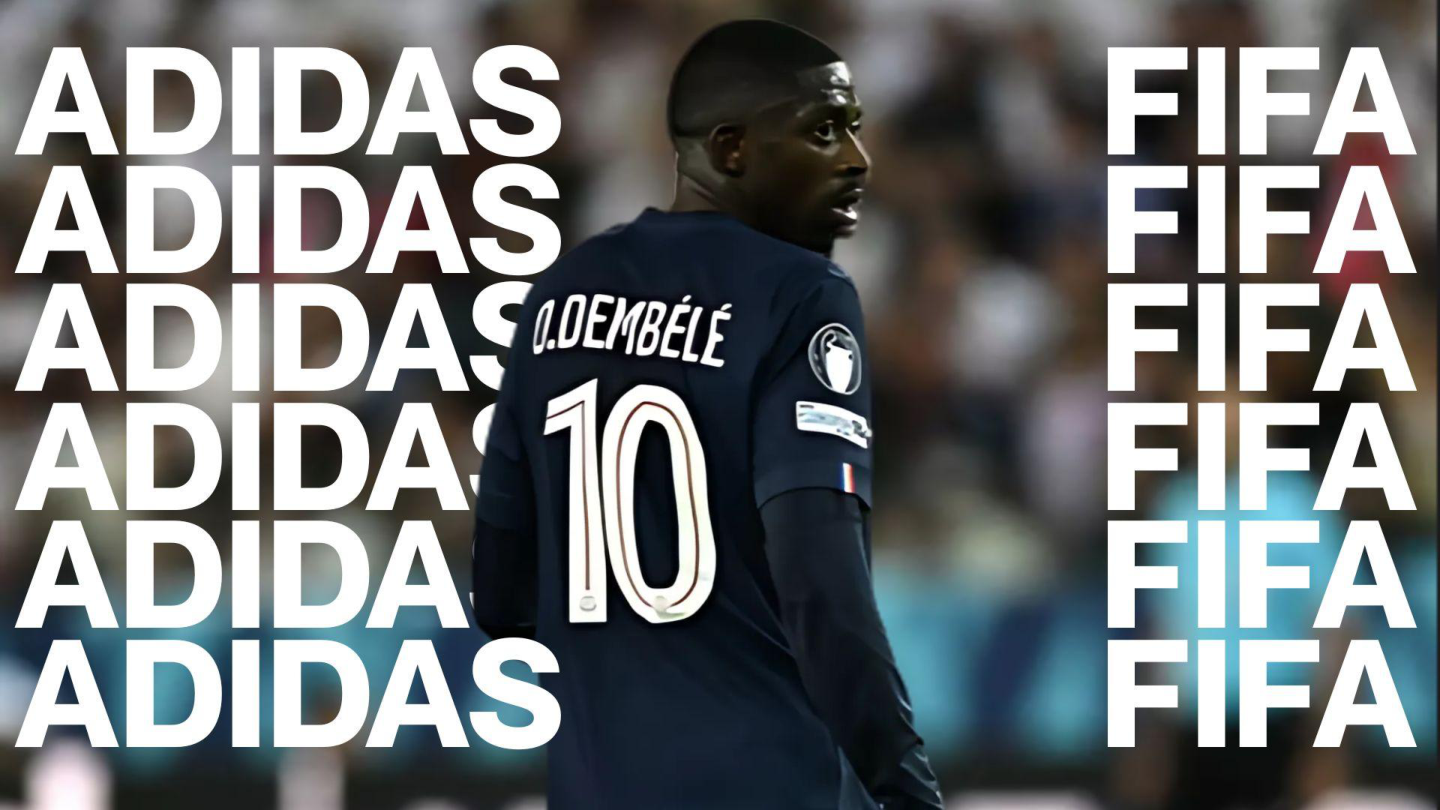
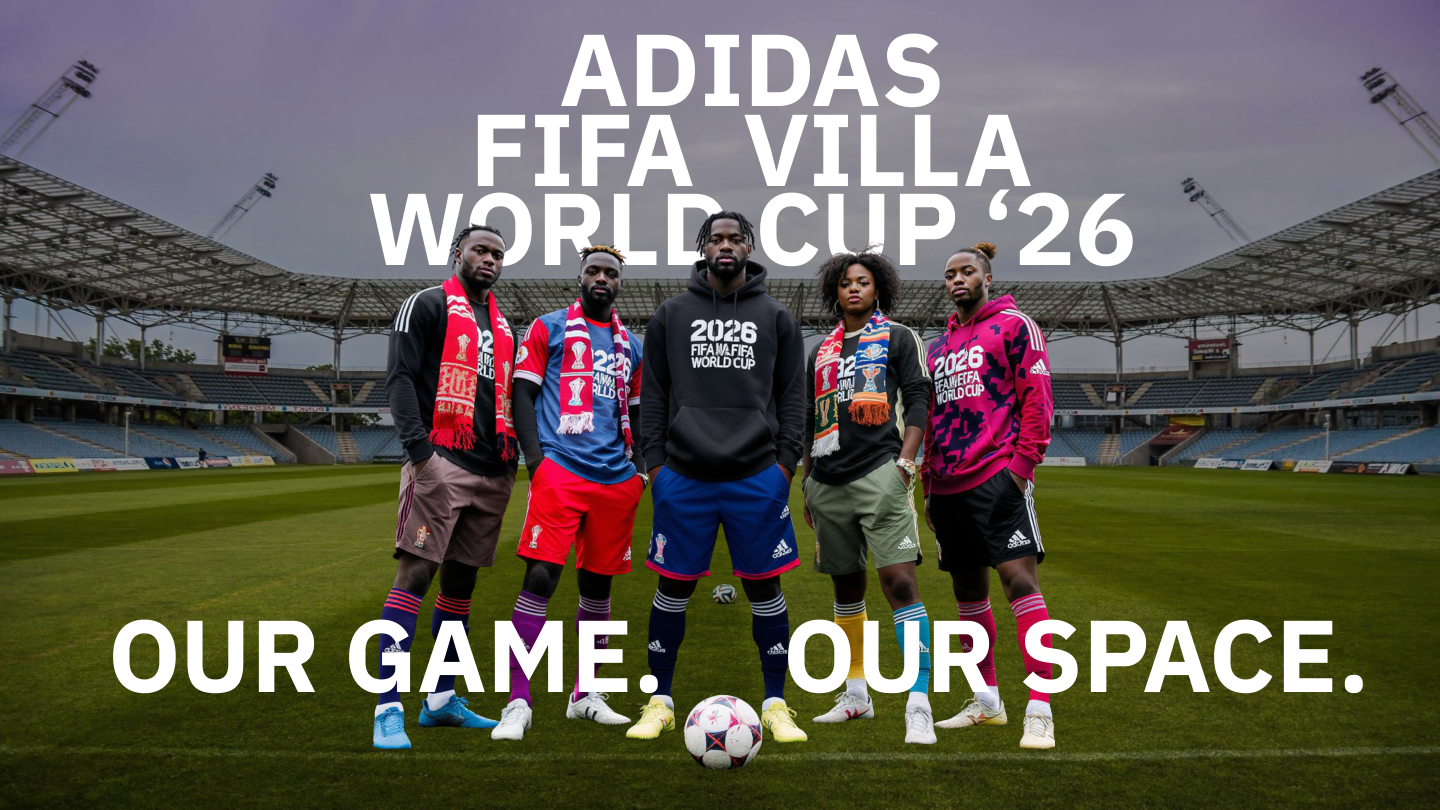
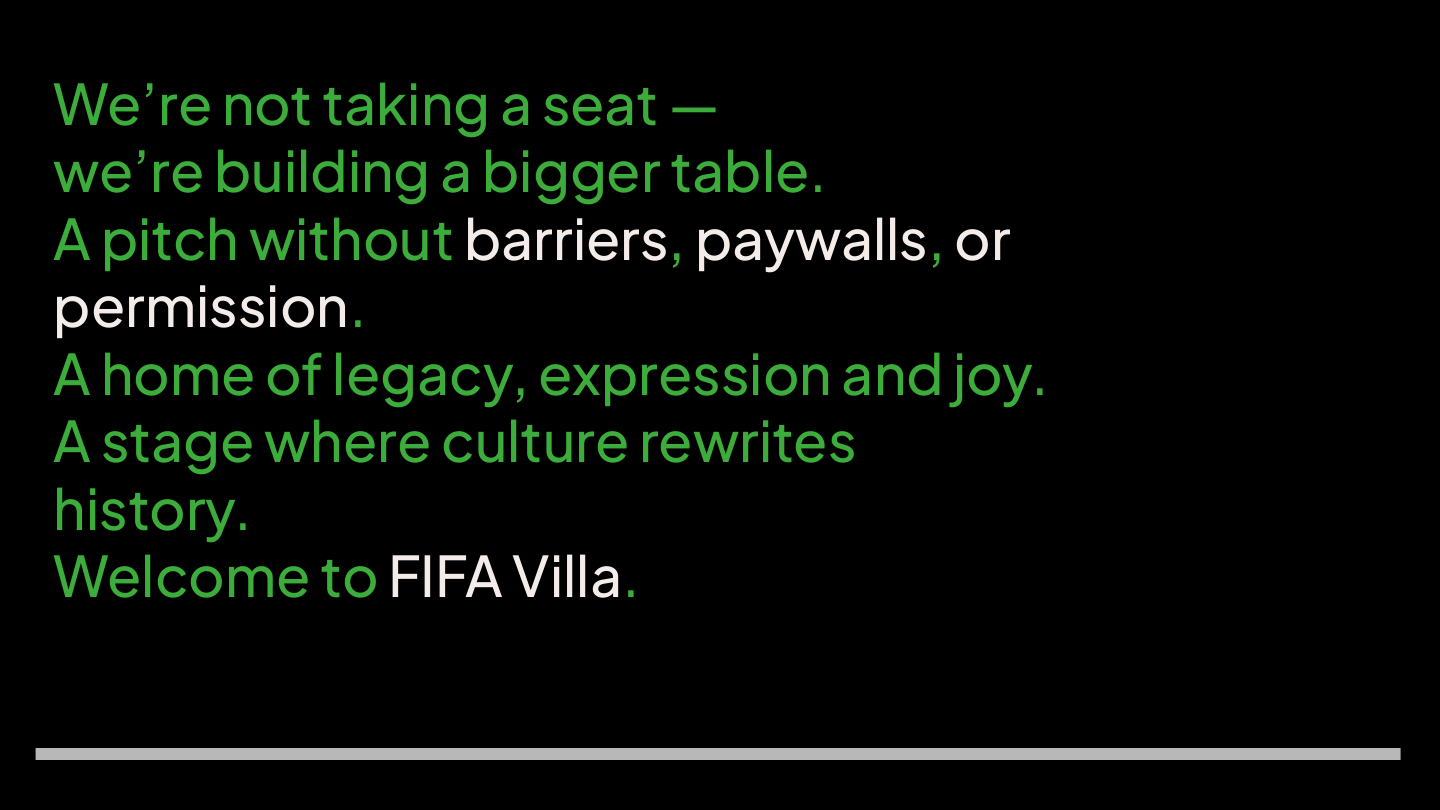
"We're not taking a seat — we're building a bigger table." A pitch without barriers, paywalls, or permission. A home of legacy, expression, and joy. A stage where culture rewrites history. Welcome to FIFA Villa.
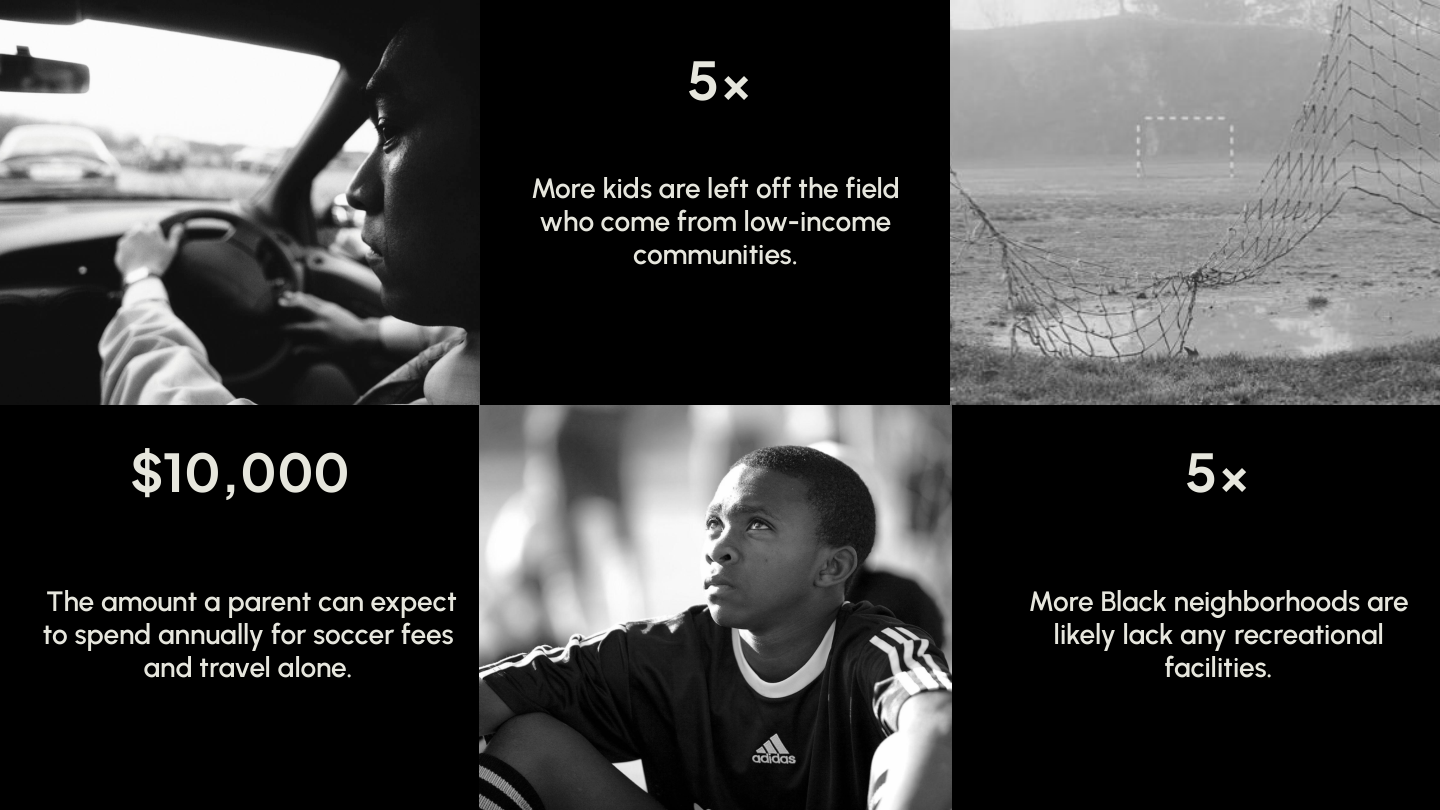
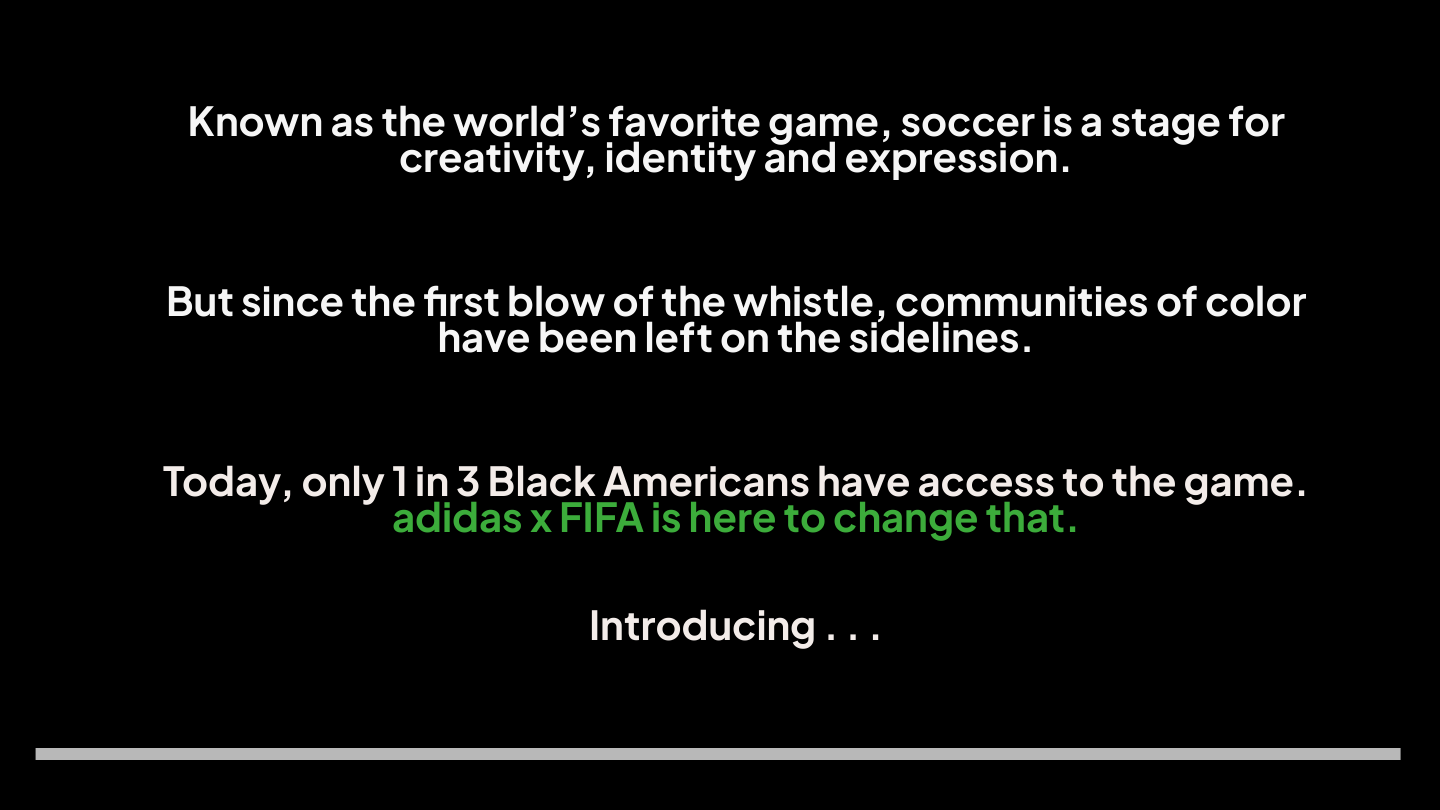
Soccer is the world's most popular game — but communities of color have been left on the sidelines since the first blow of the whistle. The barriers are structural, and the research is unforgiving:
Today, only 1 in 3 Black Americans have access to the game. Ahead of the 2026 World Cup hosted on U.S. soil, adidas had a once-in-a-generation moment to address that gap on the world stage. FIFA Villa is the answer.
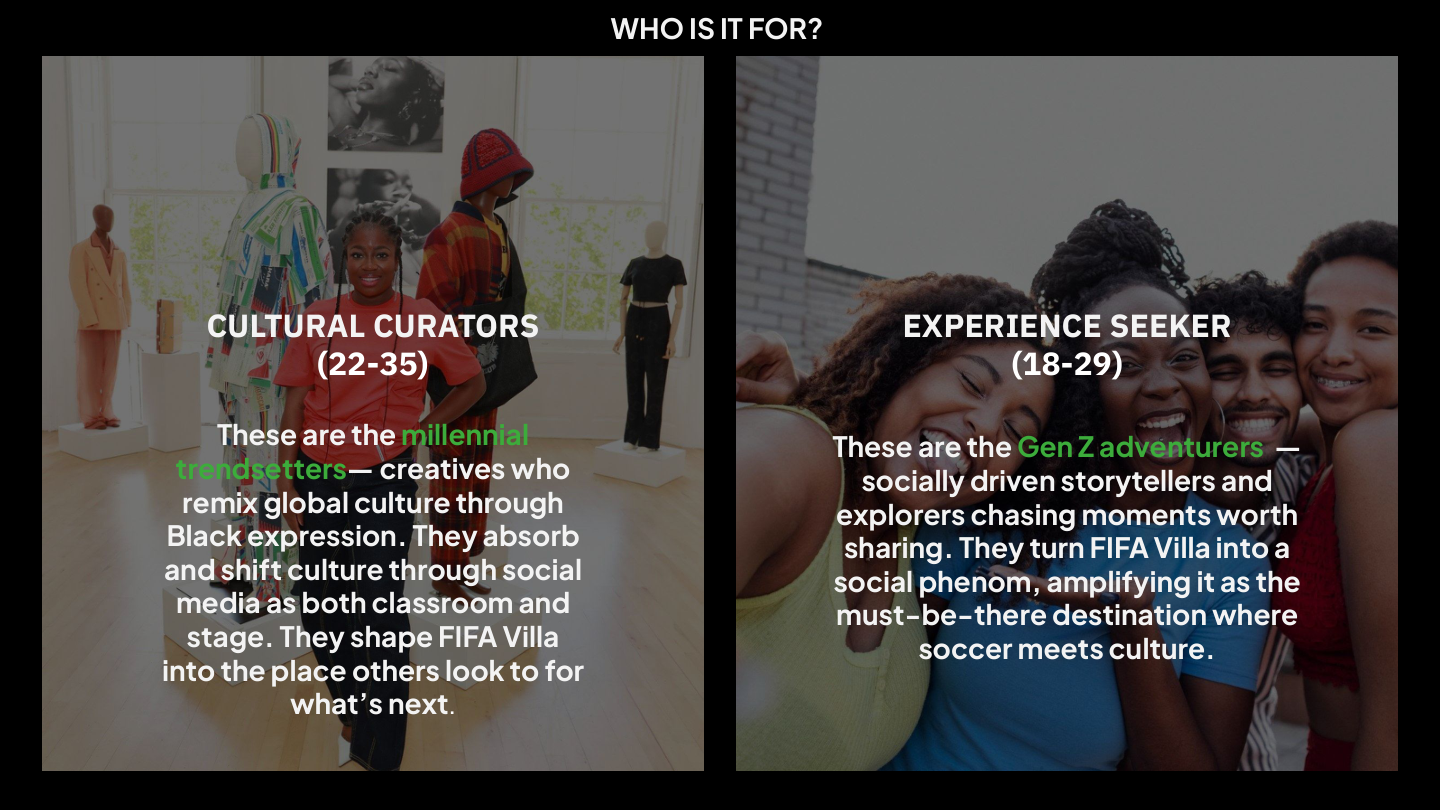
Millennial trendsetters — creatives who remix global culture through Black expression. Social media is both classroom and stage. They shape FIFA Villa into the place others look to for what's next.
Gen Z adventurers — socially driven storytellers chasing moments worth sharing. They turn FIFA Villa into the must-be-there destination where soccer meets culture.
The entire activation — strategy, audience, footprint, guest journey, host roster, and measurement framework — captured in a single deck. Scroll through every slide below.
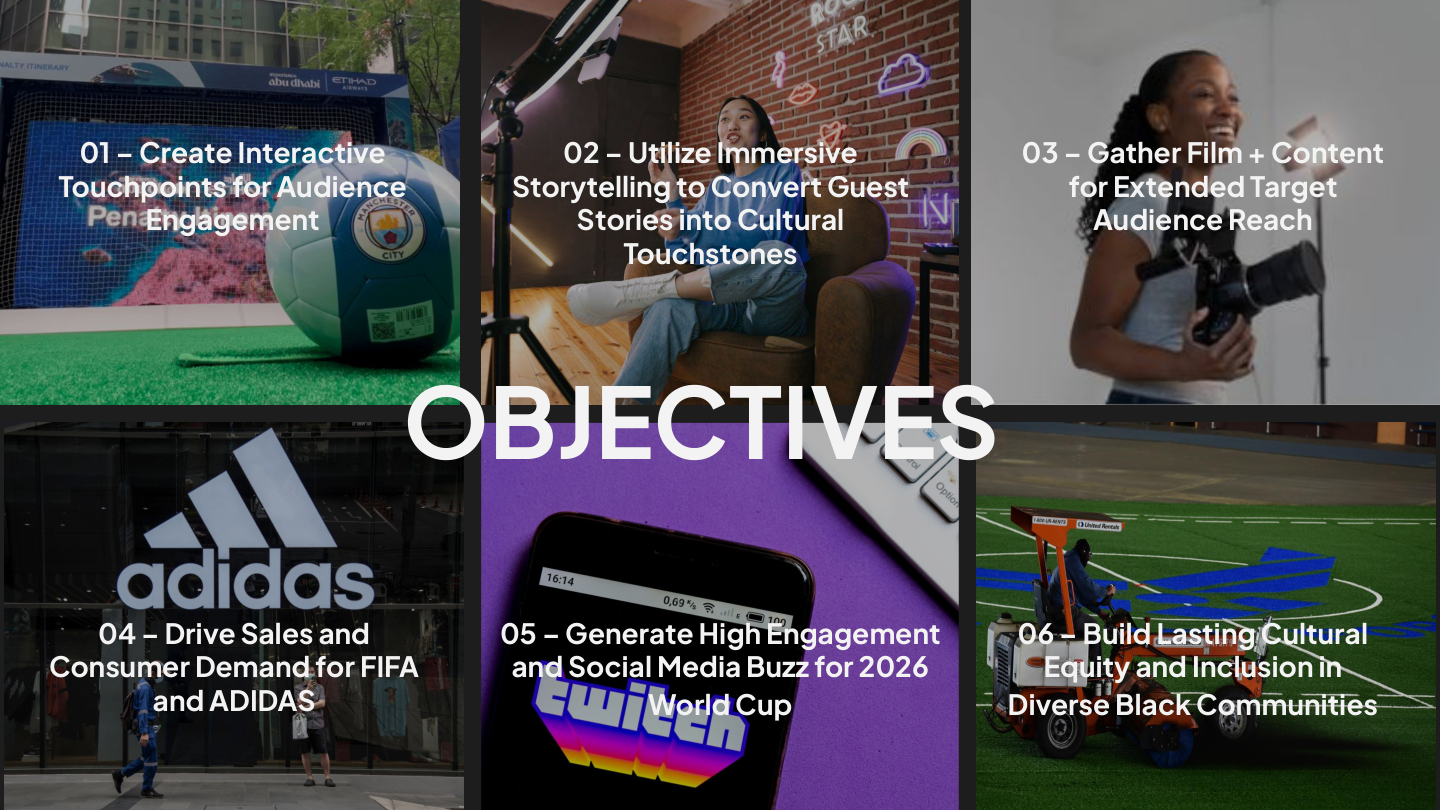
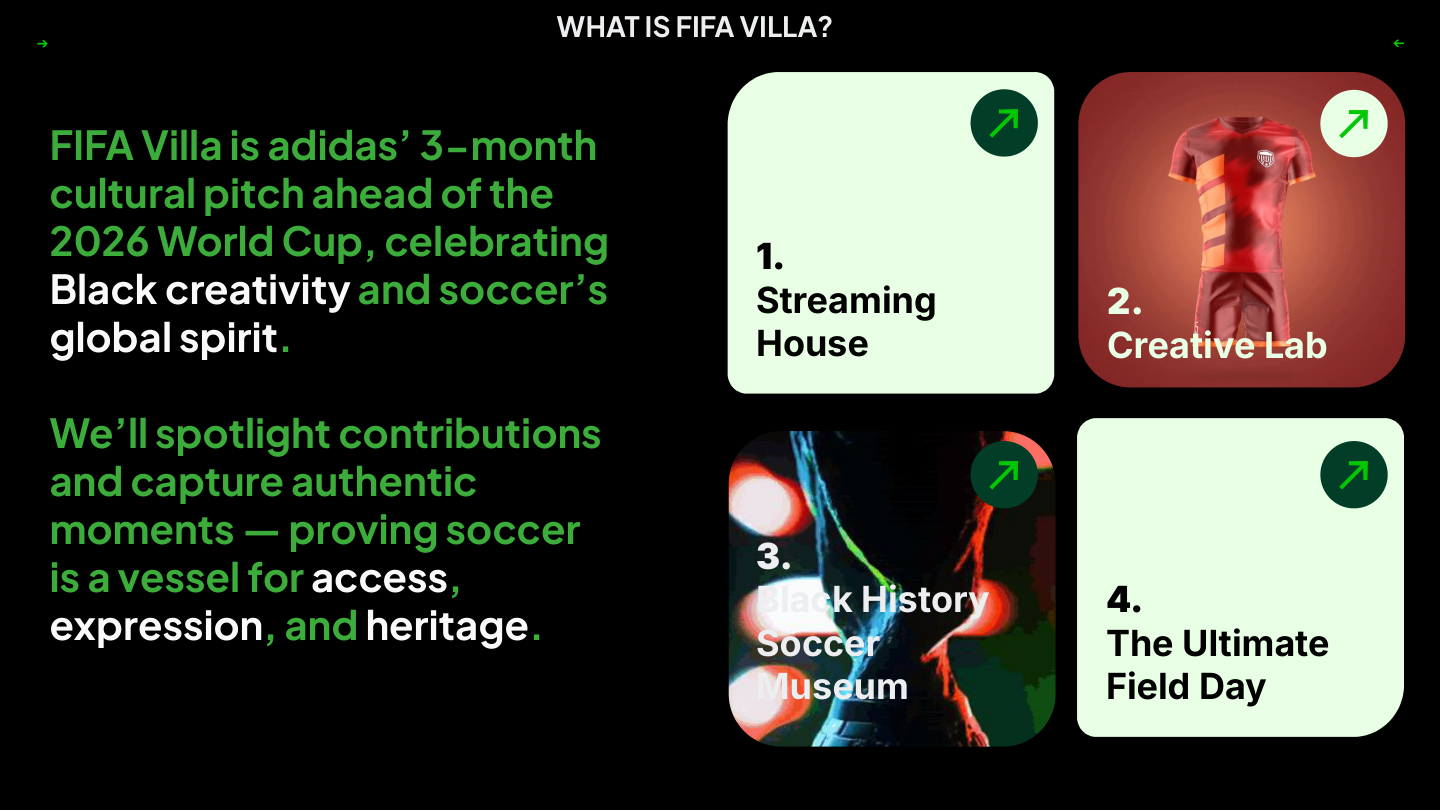
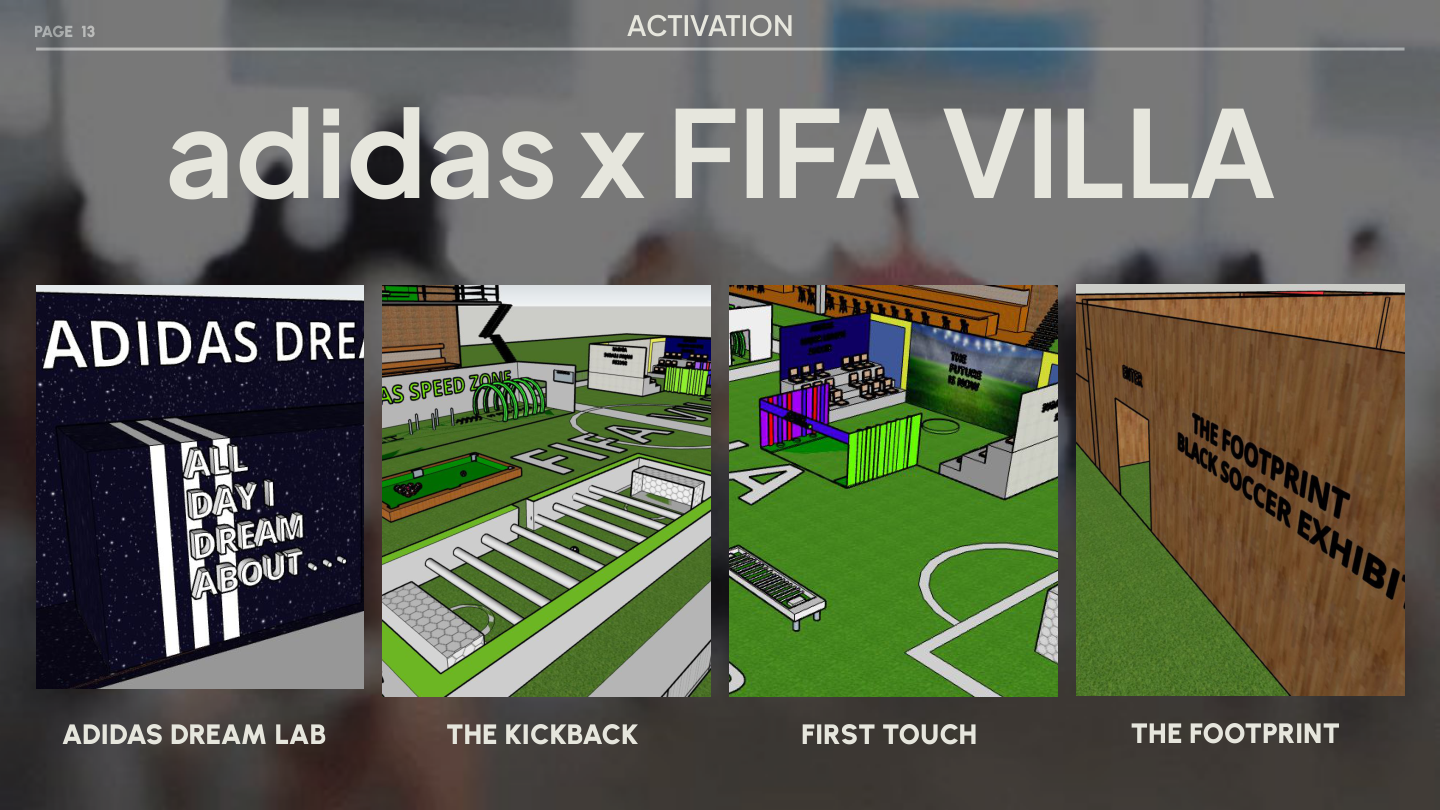
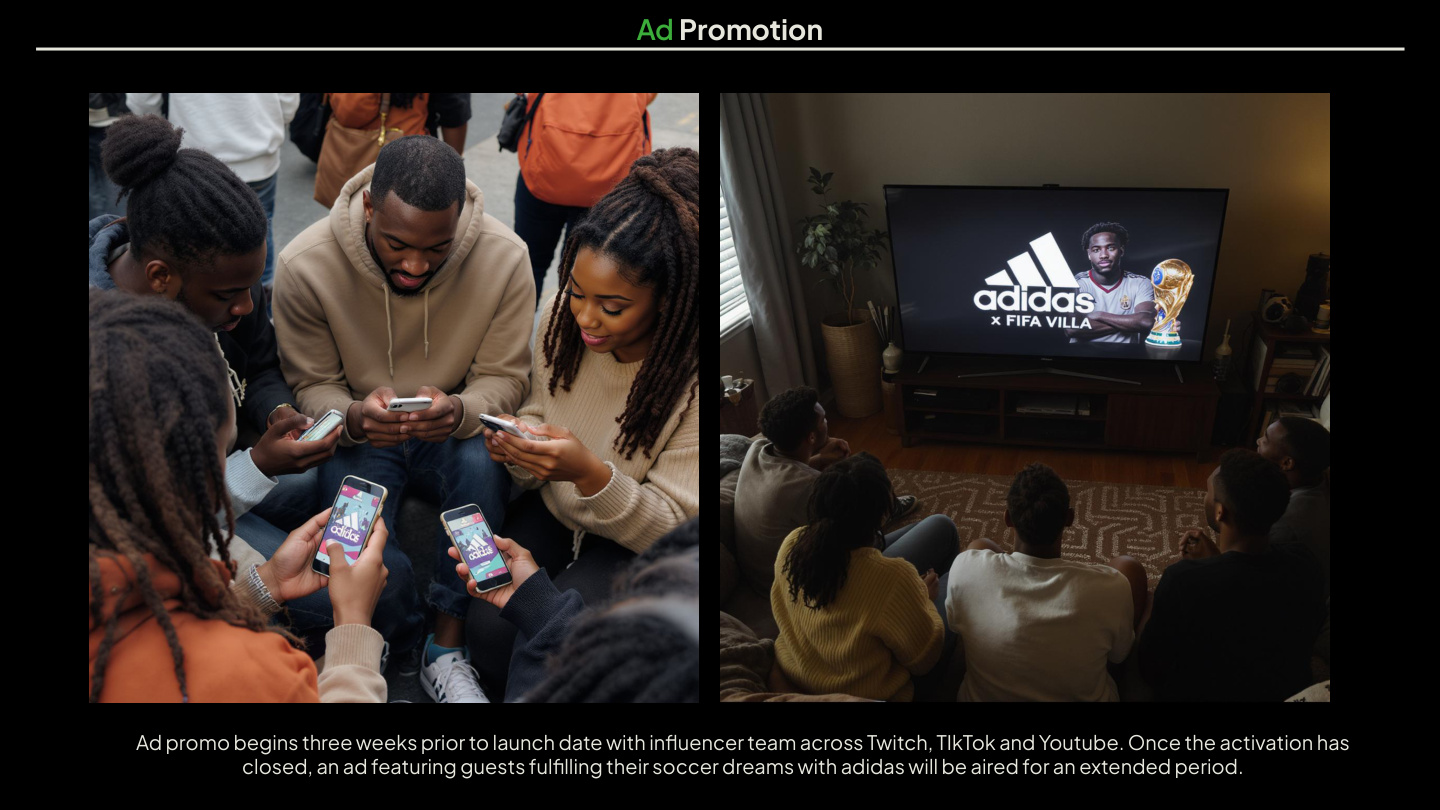
FIFA Villa is built around four distinct zones, each designed to deliver against a different objective while threading the same cultural through-line:
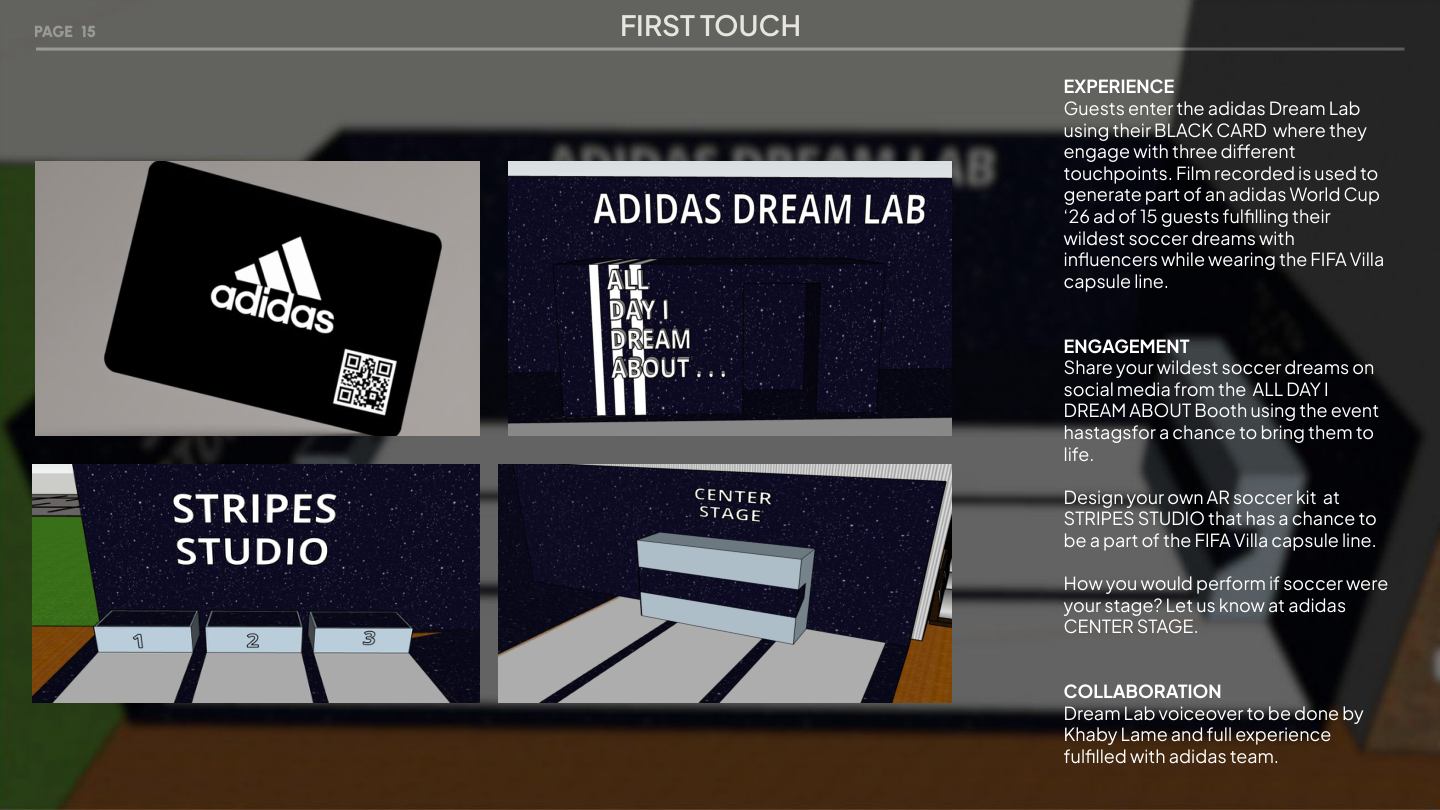
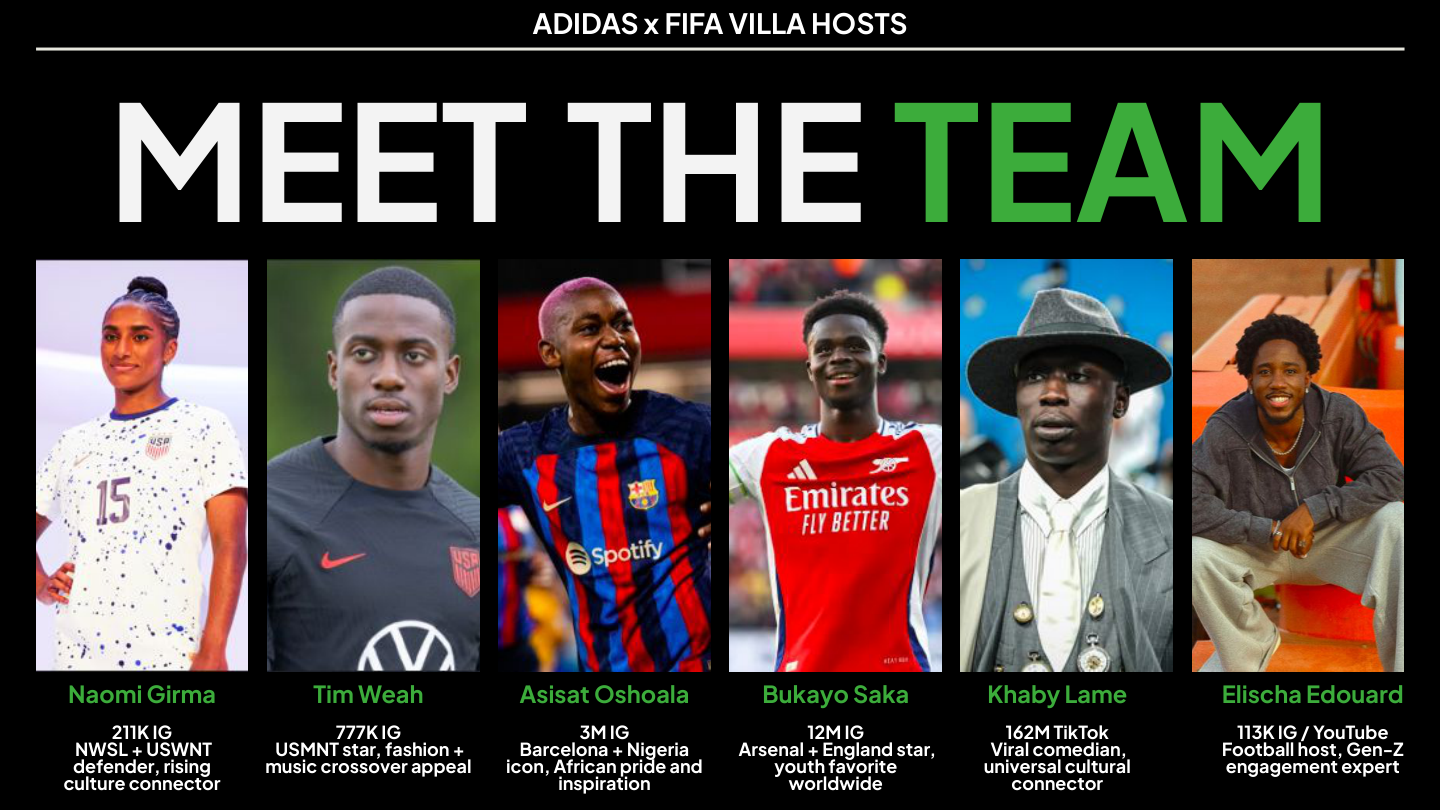
Three guest touchpoints feed a World Cup ad spotlighting 15 guests fulfilling their wildest soccer dreams. Booths: All Day I Dream About (social capture), Stripes Studio (AR kit design), and Center Stage (performance capture). Voiceover by Khaby Lame.
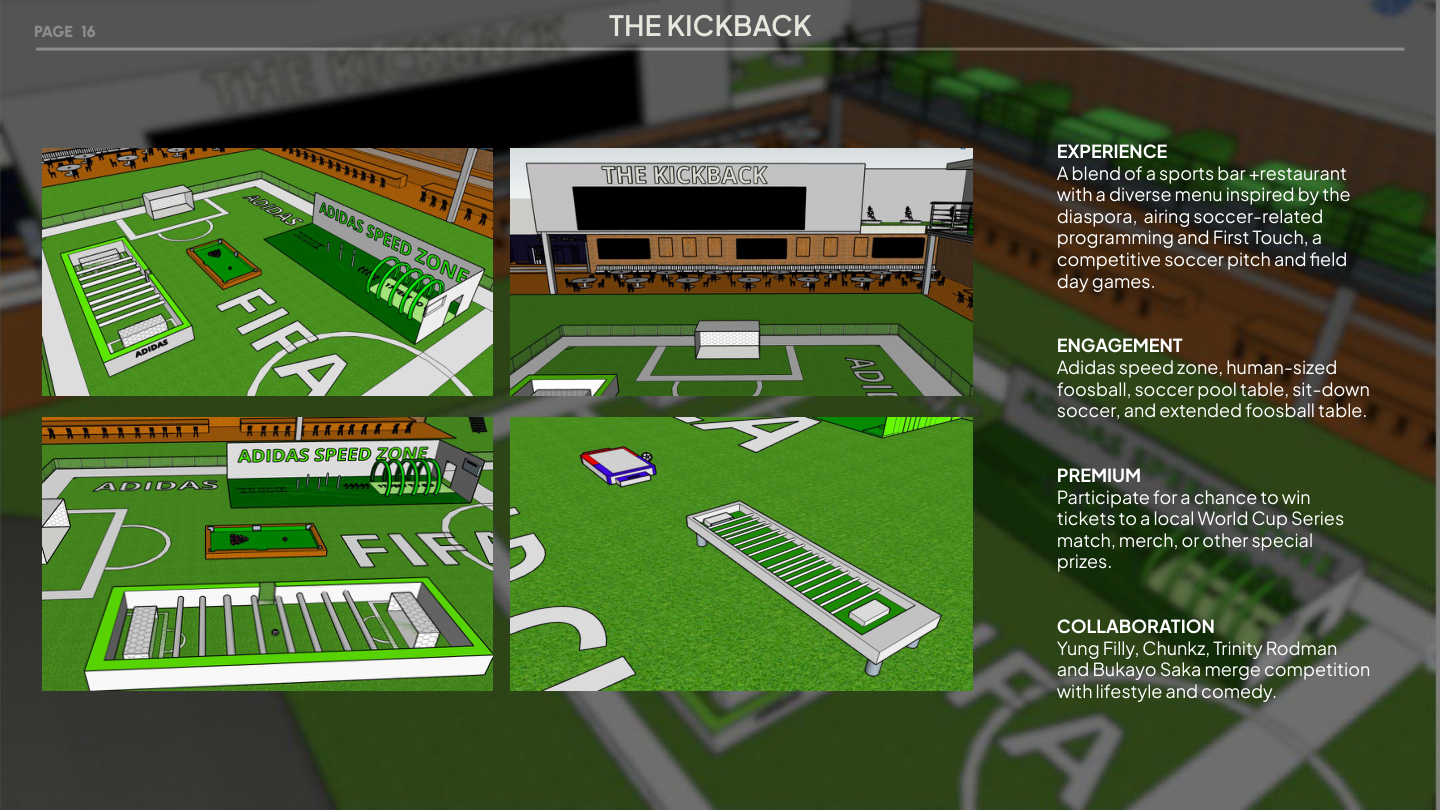
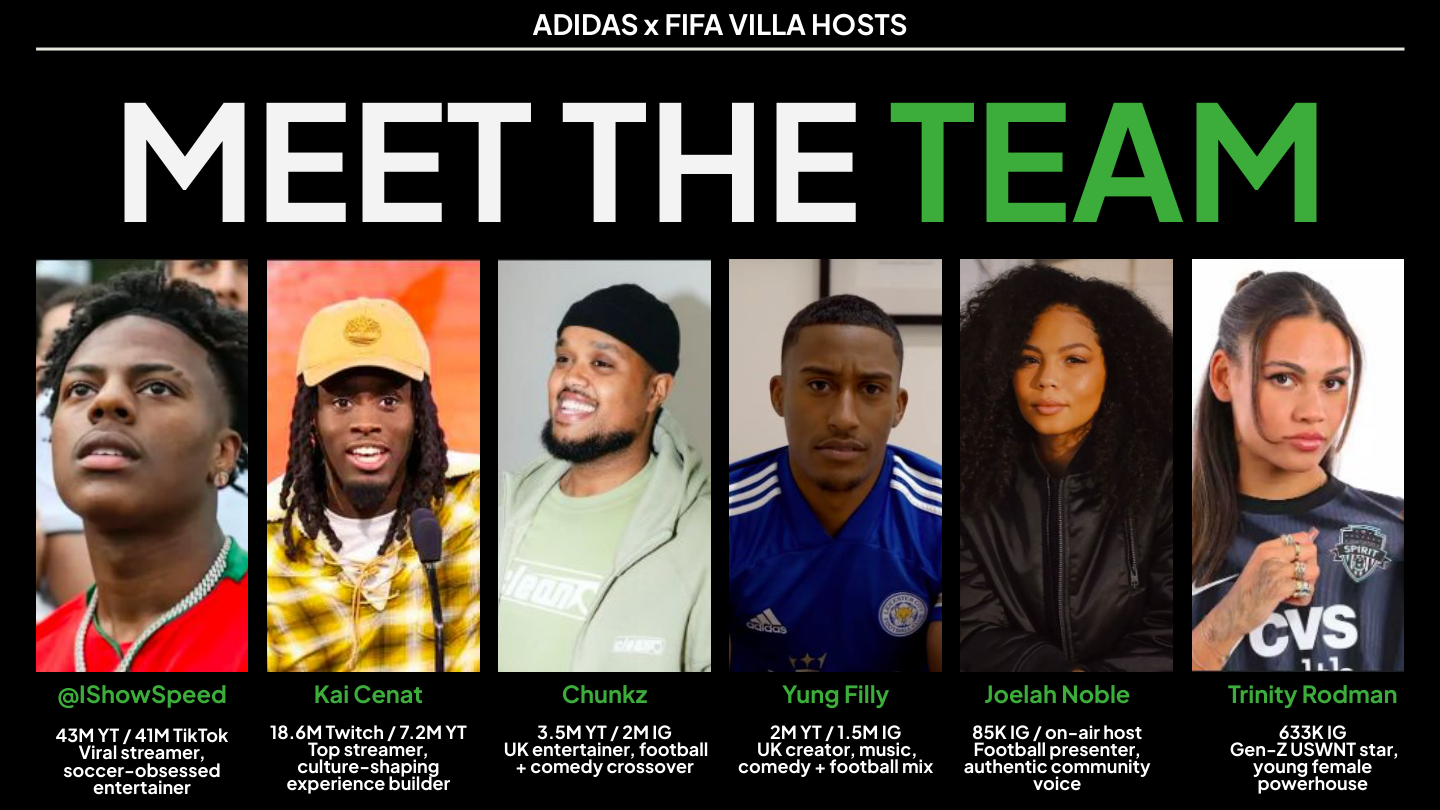
Sports bar + restaurant with a diaspora-inspired menu. Human-sized foosball, soccer pool, sit-down soccer, extended foosball, and the adidas Speed Zone. Hosted by Yung Filly, Chunkz, Trinity Rodman, and Bukayo Saka.
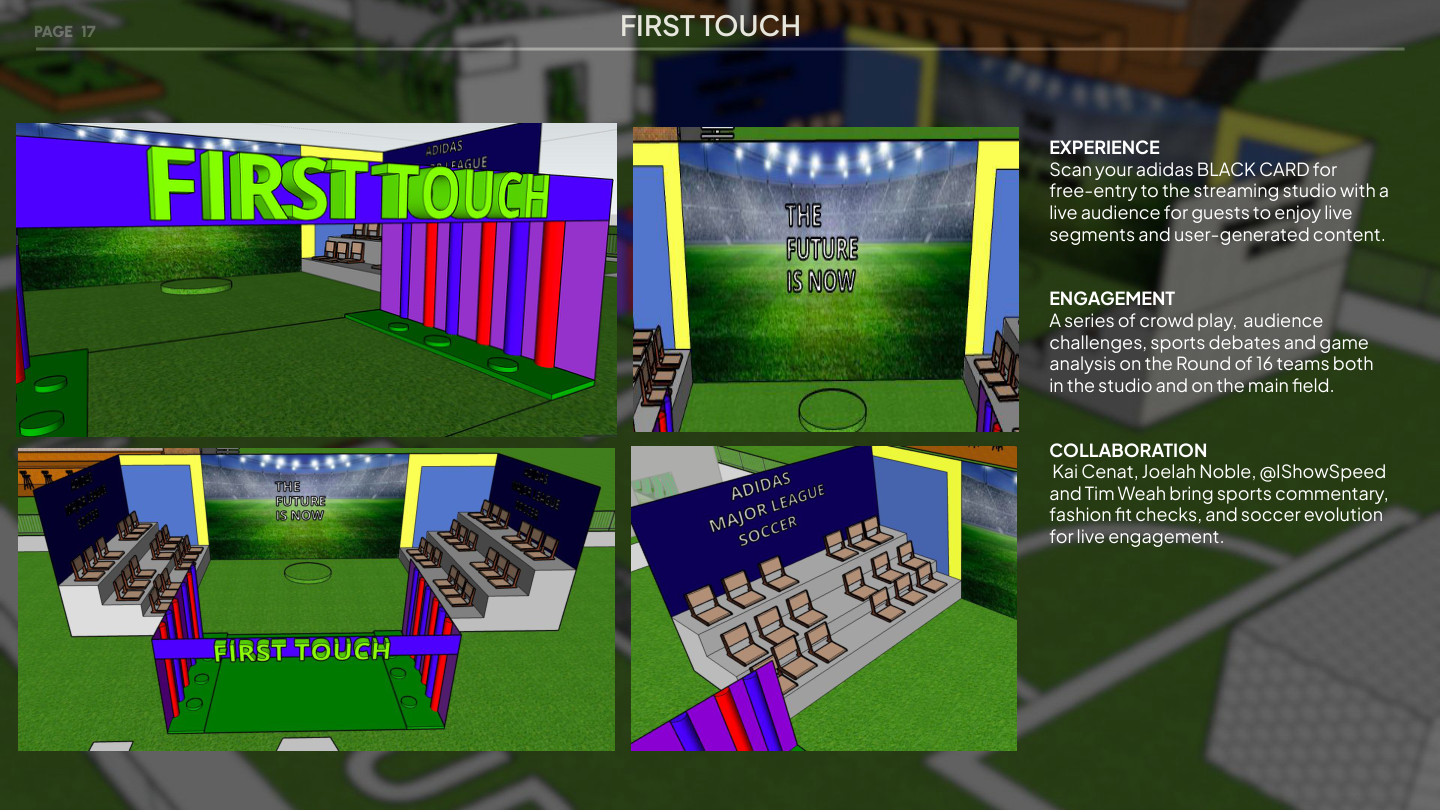
Free-entry streaming studio with a live audience. Crowd play, sports debates, and Round-of-16 analysis. Featuring Kai Cenat, Joelah Noble, IShowSpeed, and Tim Weah.
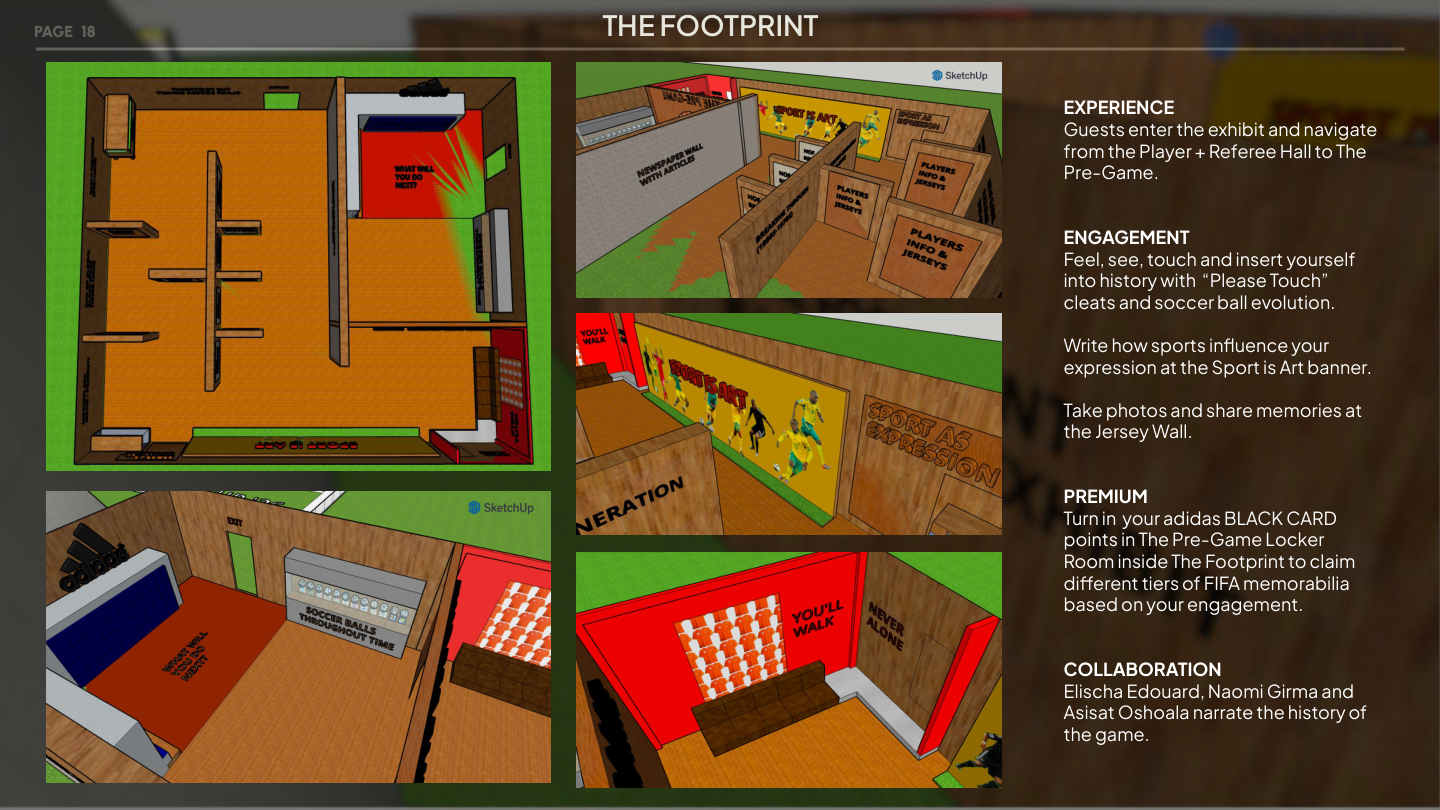
"Please Touch" cleat & ball evolution exhibit, Sport Is Art banner, Jersey Wall photo moment, and the Pre-Game Locker Room where Black Card points unlock tiered FIFA memorabilia. Narrated by Elischa Edouard, Naomi Girma, and Asisat Oshoala.
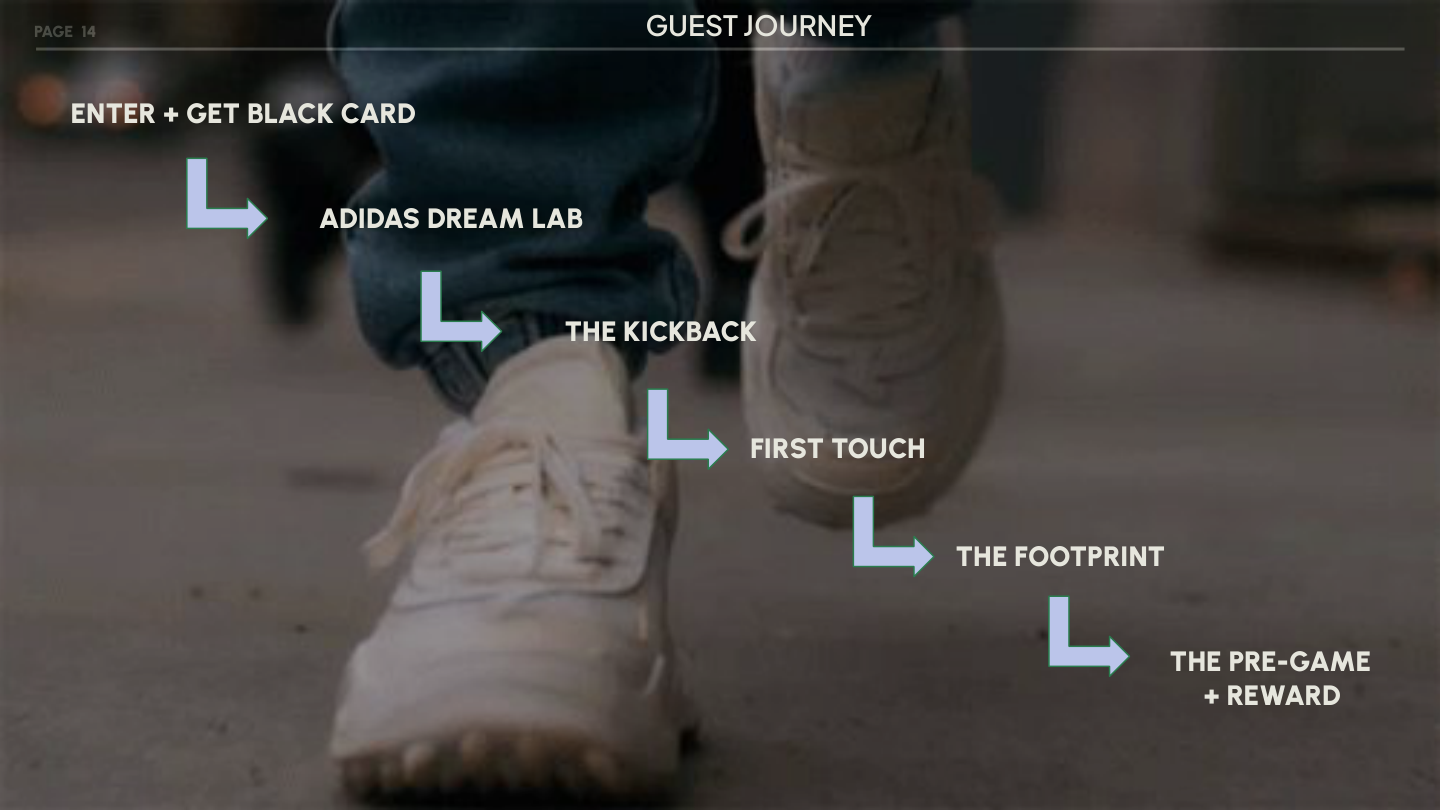
Every guest moves through six designed stages, with the adidas Black Card as the connective tissue:
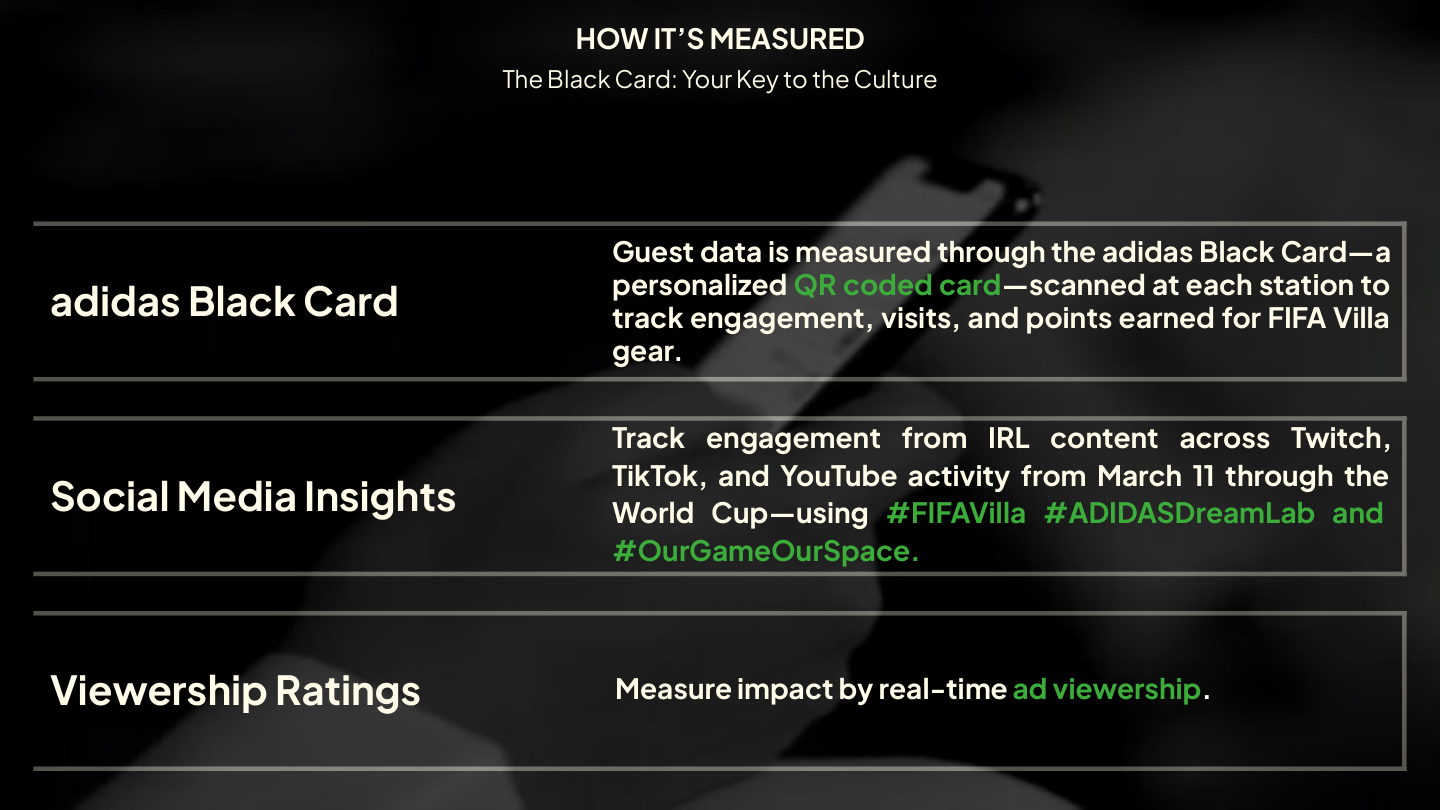
QR-coded personalized adidas Black Card — your key to the culture. Tracks engagement, visits, and earned points across every station.
The pre-game. Share your wildest soccer dreams, design an AR kit, and perform on Center Stage — content captured for the World Cup ad.
Food, drinks, oversized games, and the Speed Zone. Where culture loosens up and the social moments live.
Streaming studio engagement. Crowd play and Round-of-16 analysis with the host roster.
Black History Soccer Museum. Touch the artifacts, write your story on the Sport-Is-Art banner, photograph the Jersey Wall.
Redeem your Black Card points in the Locker Room for tiered FIFA memorabilia — the higher your engagement, the better the unlock.
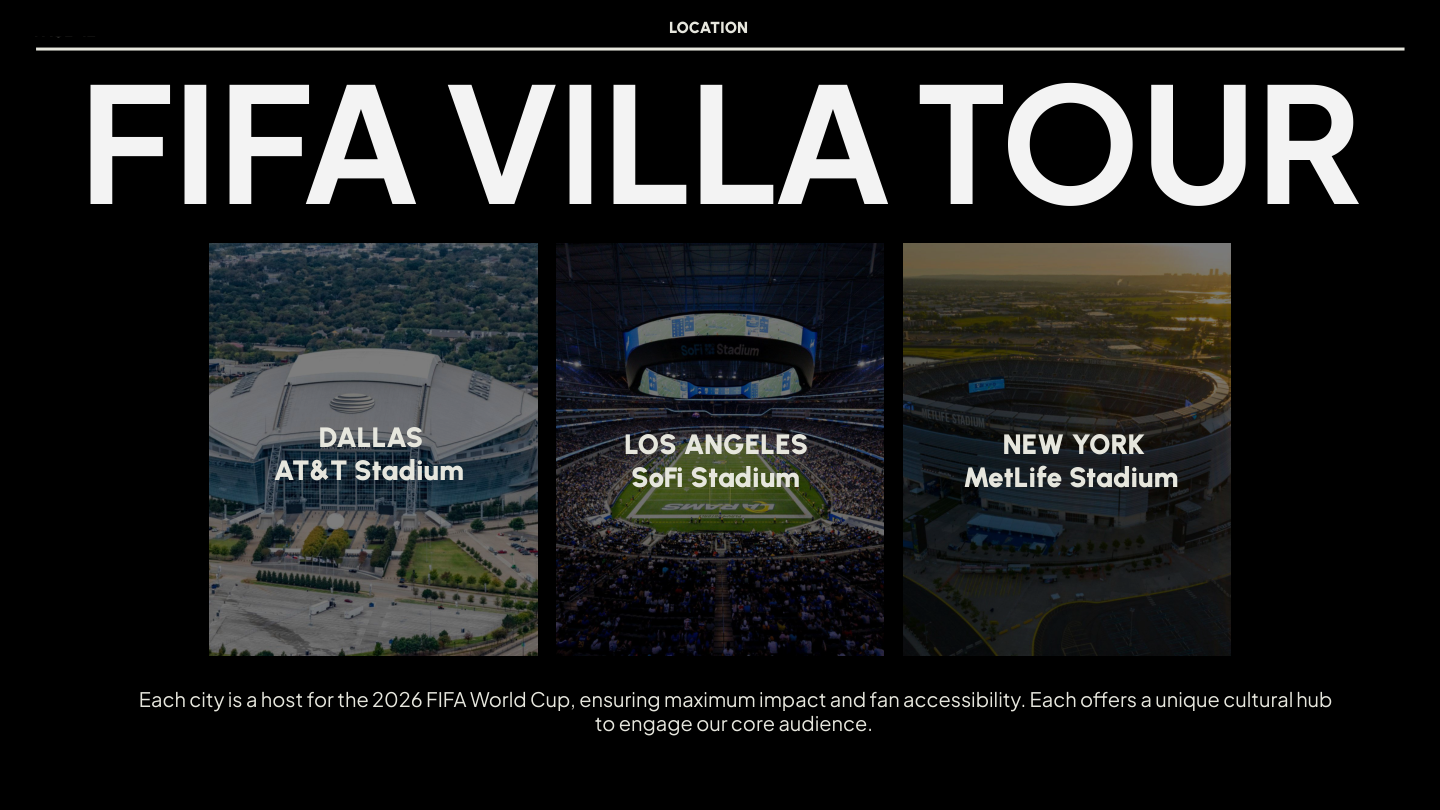
Three U.S. host cities — each tied to a confirmed 2026 World Cup stadium, ensuring maximum fan accessibility and cultural reach:
Measurement was designed into the program from day one, across three layers:
Twelve cultural hosts engineered to span Gen Z and millennial cultural curators across streaming, soccer, comedy, and fashion — with a combined audience well into the hundreds of millions:
Ad promotion kicks off three weeks before launch with the influencer roster across Twitch, TikTok, and YouTube. Once the activation closes, a hero ad featuring guests fulfilling their soccer dreams with adidas runs for an extended post-event period — turning a 3-month physical activation into 12+ months of cultural equity.
Authored end-to-end. The deck demonstrates an approach to large-format cultural activations: research-led, audience-specific, structurally bold, and measurable from day one.
A pitch-ready, end-to-end activation concept with a built 3D footprint, defined audience segments, an influencer roster, and a measurement framework — the kind of deck that gets a meeting with brand leadership. Also a writing and design sample for the work built to ship next.